For Authors
A concise reference for everyone preparing, submitting, or revising a manuscript for YTUP — from first draft to published article.
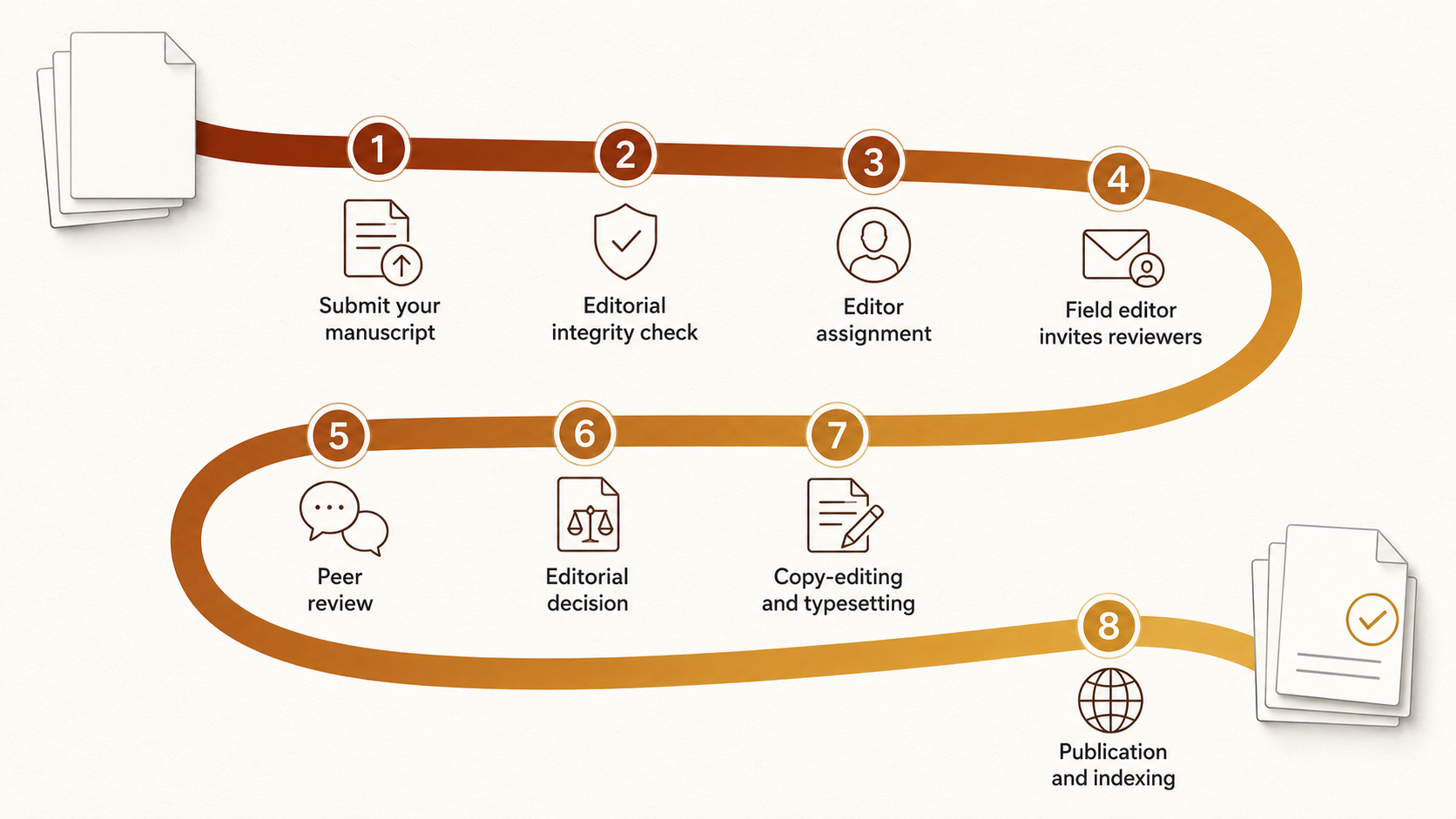
Before you submit
A few checks now prevent delays later. Before you open the submission portal, confirm the following:
- Scope check.Read the journal's Aims & Scope page. YTUP publishes original research, review articles, and brief communications in engineering and applied sciences. If your topic sits at the edge of scope, email the editorial office with a title and 150-word abstract before investing time in a full submission.
- Ethical declarations.Every submission must be accompanied by a signed authorship and ethics declaration confirming that the work is original, has not been published elsewhere, and conforms to the journal's policies on data fabrication, image manipulation, and plagiarism. Research involving human participants or animals requires an institutional ethics approval reference.
- ORCID iDs. The corresponding author must hold a valid ORCID iD, entered during account registration. Co-authors are strongly encouraged to provide theirs as well. ORCID iDs are embedded in the published metadata and facilitate accurate indexing and credit attribution.
- Co-author agreement. Ensure every named author has read the final manuscript, agreed to the author order, and consented to submission. Disputes about authorship after submission are costly for everyone; resolve them before the manuscript is uploaded.
Submission requirements
File formats and sizes
- Manuscript file: PDF or DOCX, maximum 20 MB. Figures embedded in the document are acceptable for review; high- resolution source files (TIFF, EPS, or PDF) will be requested at the production stage.
- Supplementary materials: PDF, XLSX, or CSV, maximum 50 MB per file. Archive bundles (.zip) are accepted for data sets and code.
- Figures (standalone): TIFF (300 dpi minimum) or vector PDF. JPEG is accepted for photographs only, not for charts or diagrams.
Naming conventions
Name your main manuscript file manuscript.pdf or manuscript.docx. Figures should follow the convention fig01.tiff, fig02.tiff, etc. Avoid spaces, accented characters, or version suffixes in file names.
Required artifacts
- Cover letter (required): one page addressing the editor. State the article type, confirm the manuscript is not under consideration elsewhere, summarise the scientific contribution in 3–5 sentences, and optionally suggest or exclude reviewers.
- Authorship and ethics declaration (required): a signed statement available as a template in your author dashboard. All co-authors must be listed and must have agreed to the declaration content.
- Response letter (required for revised submissions only): a point-by-point response to every reviewer and editor comment, uploaded alongside the revised manuscript. Number each response to match the corresponding comment number in the decision letter.
Review timeline
Durations below are targets, not guarantees. Reviewer availability and manuscript complexity can extend any stage.
Decision categories
Every manuscript receives one of four editorial decisions. The decision letter will explain the outcome and, where applicable, list specific changes required.
The manuscript is accepted as submitted or with only minor editorial corrections that do not require re-review. No further review round occurs. The manuscript proceeds directly to production.
The manuscript requires limited, clearly specified changes — typically clarifications, additional citations, or small adjustments to figures or tables. A revised version is returned to the handling editor, who may accept it without sending it back to reviewers.
Substantial revisions are required: additional experiments, significant restructuring, or a materially rewritten section. The revised manuscript is sent back to the original reviewers, who issue a further recommendation. A major revision is not a rejection; it reflects that the work has merit worth developing.
The manuscript does not meet the journal's standards for originality, methodology, or scope, and revision cannot be expected to remedy the fundamental issues identified. Authors may submit a new manuscript addressing a different study to the journal in the future.
After acceptance
Once the editor issues an acceptance decision, the manuscript moves to the production team. The following stages happen in order:
- Copyediting. A professional editor checks grammar, spelling, punctuation, and adherence to journal style. Minor clarifications may be introduced; substantive content is not changed without author approval.
- Typesetting.The copyedited text is laid out in the journal's house template. Figures are reproduced at publication quality; tables are reformatted to journal style.
- Proofreading. A proofreader checks the typeset proof against the accepted manuscript to catch typesetting errors. This is an internal step; authors are not involved.
- Author proof approval. A PDF proof is emailed to the corresponding author for final review. Authors have 72 hours to approve or flag errors. Only corrections of typesetting errors are permissible at this stage; new content cannot be introduced.
- Publication. After approval, the article is assigned a DOI, uploaded to the journal platform, and submitted for indexing in applicable databases. The corresponding author receives a publication notification with the live URL.
Frequently Asked Questions
Common questions from authors, reviewers, and editors.